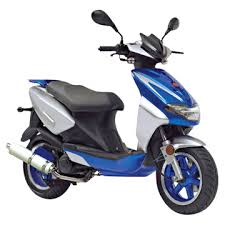
Since motor scooters took the world by storm, there has been a lot said about them. Various publications have written about them and TV shows have also featured them extensively. In a world where gas prices are constantly climbing, scooters have become the new way of commuting without breaking the bank. In some world cities such as Jakarta Indonesia, Calcutta India and Shanghai China, motor scooters are literally as numerous as motor vehicles. In the US, the scooters have also risen in popularity and have been used extensively as commute and recreational vehicles. But how safe are motor scooters?
Motor scooters are one of the most convenient ways of traveling ever invented. As we mentioned, it is common knowledge that the world is in an economic crisis. One of the factors that have accelerator the economic woes of many families is the price of gasoline. This has continued to rise even when we have been assured that there is no problem of gasoline supply. Motor scooters have become extremely popular in many places because of their fuel efficiency. This has resulted in massive sales especially in emerging and developing nations. Developed nations also have seen an increase in motor scooter sales in the past few years. This means that on our roads today, we are more likely to see more motor scooters than ever before.
The influx of motor scooters on our roads in large numbers is not without its ramifications. The scooters compete for space with motor cars, motorcycles, bicycles, trucks, buses, trains and even pedestrians. In the event of a collision between a scooter and a car, the rider of the scooter is bound to sustain serious injuries. It is therefore recommended that one never ride a motor scooter without proper protective clothing. One mandatory pierce of equipment was the helmet. Without a helmet, a collision, even a minor one, can be fatal for the motor scooter rider.
One of the reasons why people especially the younger ones prefer scooters is because of the ability to weave through traffic. While this can minimize the chances of being caught in a traffic jam, it is nonetheless dangerous. Trying to jostle for space in busy city streets can be dangerous.
Scooters are relatively safe because they are slightly slower than regular motorcycles. They are also less maneuverable than high-speed motorcycles. This makes scooters safer because there is a wide range of movements that they simply cannot undertake. Because they are slower, they are also easy to control.
All in all, scooters are relatively safe but it is recommended that you compliment that safety by wearing protective gear. This is a good helmet, leather gloves and knee pads and good shoes. Heavy windbreakers are also recommended if you are riding in windy terrain. Many scooter manufacturers perform crash tests on their units and different makes and models have different crash test ratings. It is recommended that you analyze this before you commit to buying.

September 28, 2009
How Safe Are Motor Scooters?


Buell Lightning CityX XB12SX 2010 Motorcycle
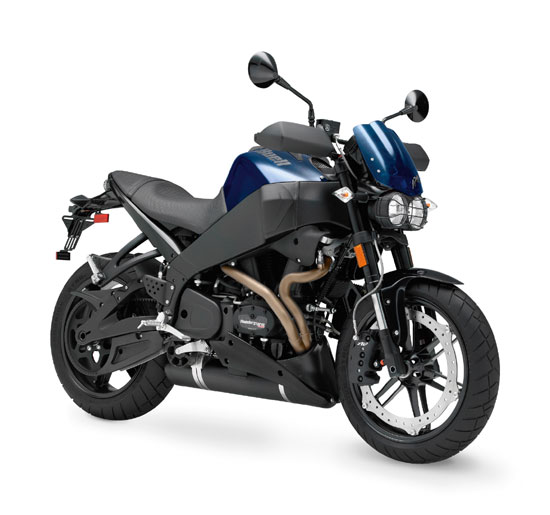
Receiving its debut in Europe, Buell Lightning CityX XB12SX joins the sheer power of the Thunderstorm 1203cc V-Twin engine with Buell’s popular Lightning CityX XB9SX chassis and suspension, inspired by the needs of today’s urban riders. Delivering a whopping 104 Nm/ 77 ft lbs of torque, the Buell Lightning CityX XB12SX bike is available in Valencia Orange Translucent & Hero Blue Translucent, both with black wheels.
Motorbikes at Mid-Life - What Crisis?
For years, the sound of the engine and the feeling of freedom has been kept at arm's length by nothing more than just life. Well, the first half anyway. But now, mid way through your stint on this planet, it's time to face up to your responsibilities, admit you're at 'mid-life' (whether you're in crisis or not) and refuse hands down any notion of growing old gracefully.
As such, a motorbike is the perfect antidote to any psychological or physical conditions akin to that phase of life whereby youthful reminiscence and fear of impending old age go hand in hand. Of course, the need to define this chapter of your life, termed helpfully as a 'mid-life crisis', is all too apparent. But what better way then, than head on with a two wheeled motorised machine that oozes freedom. Whether you are taking a spin through the countryside on a Sunday afternoon or planning the ultimate road trip, stress levels are demanded to subside; and any feelings of disappearing youth naturally disappear.
If this sounds all too compelling and the thought of purchasing that first bike is becoming too alluring to ignore, then take the plunge. You'll need to start doing your research of course, particularly if you're new to the world of motorbikes. Knowing your CC's from your BHPs and your 2 strokes from your 4 strokes are just the start; the range of motorbikes produced by manufacturers such as Honda, Yamaha and Kawasaki to name but a few, is vast. But ultimately your bike of choice will come down to your preference for speed, acceleration and reliability.
Indeed, you'll want to look the part as well. A suitably coloured leather jacket and trousers would be needed for protection as opposed to style; whilst gloves, boots and a helmet would all form part of your long list of accessories.
However, it is important to understand that when purchasing any new mode of transport, preparation is crucial. So when purchasing your motorbike of choice, don't forget essentials such as motorbike insurance, checking you have a valid licence and ensuring you have the right equipment. Furthermore, perhaps take some lessons and then when all of that is in place, let any remaining follicles on that head of yours down.
And whether you are an all-out enthusiast or just a casual rider, a motorbike at any time of life can be great fun. But at mid-life, it just feels better!
Isla Campbell writes for a digital marketing agency. This article has been commissioned by a client of said agency. This article is not designed to promote, but should be considered professional content.
KTM 990 Adventure
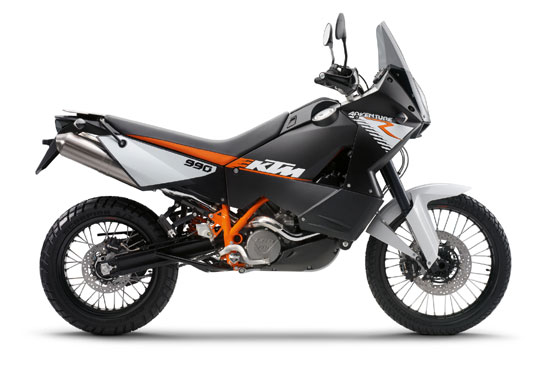
2009 KTM 990 Adventure S
The 990 Adventure S is impressive proof of just how sporty a street enduro can be. The chassis is even more extreme than the sister bike, the 990 Adventure, while the new engine has more displacement and electronic fuel injection. The “Dakar” design is a clear signal that the 990 Adventure S comes directly from rally sport.
2009 KTM 990 Adventure S - Specifications
Engine type Twin cylinder, 4-stroke, V 75°
Displacement 999 cc
Bore x stroke 101 x 62.4 mm (3.98 x 2.46")
Performance (homologated) 72 kW @ 8500 rpm
Max. torque 95 Nm @ 6500 rpm
Compression ratio 11.5:1
Starter/Battery E-Starter/12 V 11.2 Ah
Transmission 6 gears, dog clutch engagement
Fuel Mixture Generation Keihin electronic fuel injection
Control 4 V/DOHC
Lubrication Pressure lubrication
Engine lubrication Motorex, SAE 10W-50
Primary drive 67:35
Final drive 17:42
Cooling Liquid cooled
Clutch Wet multi-disc clutch, operated hydraulically
Motor Management Keihin EMS
Frame Chromium-Molybdenum trellis frame, powder-coated
Subframe Aluminium 7020
Handlebar Aluminium, Ø 28/22 mm (1.10/0.87"), tapered
Front suspension WP USD Ø 48 mm (1.89")
Rear suspension WP mono shock PDS with hydr. spring preload
Suspension travel front/rear 265/265 mm (10.43/10.43")
Front brake 2 x Brembo two piston, floating caliper, floating brake disc Ø 300 mm (11.81")
Rear brake Brembo two piston, floating caliper, floating brake disc Ø 240 mm (9.45")
Rims, front/rear 2.15 x 21"; 4.25 x 18"
Tires, front/rear 90/90-21"; 150/70-18"
Chain X-Ring 5/8 x 5/16"
Main silencer Twin stainless steel silencer with regulated catalytic converter
Steering head angle 63.4°
Trail 119 mm (4.69")
Wheel base 1570 ± 10 mm (61.81 ± 0.39")
Ground clearance (unloaded) 316 mm (12.44")
Seat height 915 mm (36.02")
Tank capacity approx. 22 Liters/4 litres reserve (5.81/1.06 gal)
Weight (dry) approx. 199 kg (438.7 lbs)
2000 BMW K1200LT

2000 BMW K1200LT
Here's where it pays to have lots of vacation time. While luxury and comfort are a given (check out the 6-CD changer and heated seat system), what's surprising is how well the K 1200 LT handles, cutting through corners with amazing agility. For that, you can thank the smooth shifting, 5-speed overdrive with reverse dear. The Telelever front and Paralever rear suspension. And big Brembo triple-disc brakes with ABS II. Stuff those saddlebags and go.
Standard Equipment
K 1200 LT-S (Standard)
Liquid-cooled four-stroke in-line 4 cylinder 1171cc engine
Bosch Motronic MA 2.4 engine management
Eletronic fuel injection
Reverse gear
Shaft drive
Telelever front suspension
Paralever rear suspension
ABS II antilock brake system
Adjustable seat height (two positions)
Adjustable front brake and clutch levers
Heated Grips
Electricity adjustable windshield
4.2 cubic feet of storage: topcase holds two full helmets
Four-speaker 120 watt AM?FM weatherband stero and cassette player
Integrated ignition and steering lock
Single-key lock system for ignition, steering, fuel cap, seat storage compartment locks, saddlebags, topcase
Cruise control with handlebar controls
Hazard warning flashers
Power accessory sockets in front and rear
K 1200 LT-I (Icon)
Includes equipment on Standard model plus 6-changer CD player, on-board computer with handlebar controls
K 1200 LT-C (Custom)
Includes equipment on Standard model plus 6-changer CD player, on-board computer with handlebar controls, chrome package, heated seats, and backrest with separate controls for rider and passenger
2000 BMW K1200LT Specifications:
Engine
Type Liquid cooled, four stroke in-line 4-cylinder
Bore x stroke 70.5 x 75 mm
Displacement 1171 cc
Horsepower 100 bhp @ 6750 rpm
Torque 85 lb.-ft @ 4750 rpm
Compression ratio 10.8:1
Valve gear DOHC
Valves 8 x 26.5 mm intake / 8 x 23 mm exhaust
Valve timing
(measured at 3 mm valve clearance)
Intake opens 19 degrees after TDC
Intake closes 13 degrees after BDC
Exhaust opens 7 degrees before BDC
Exhaust closes 25 degrees before TDC
Valves per cylinder Four
Camshafts Dual overhead
Engine oil capacity 3.96 quarts of API class SF, SG or SH; CD or CE
Engine oil filter Spin-on Micronic filter cartridge
Carburetion Fuel injection and electronic ignition MA 2.4
Ignition Controlled by Bosch Motronic with automatic choke control
Fuel demand Unleaded, premium fuel, 90 (AKI)
Fuel tank Polyamide tank with enclosed fuel pump & filter
Fuel capacity 6.2 U.S. gallons including 1 gal. reserve
Air Filter Paper-type element
Charging system 14 V, 60 Amp Alternator (840 W)
Battery BMW Mareg, 19.5 Amp/h low maintenance
Cooling system Water cooled
Drivetrain
Primary drive Helical-cut gears with tensioner
Clutch 180 mm dry, single plate with hydraulic action
Gear ratios 1st gear: 2.05:1
2nd gear: 1.60:1
3rd gear: 1.27:1
4th gear: .96:1
5th gear: .70:1
Reverse Aid: 115.7:1
Drive system Enclosed driveshaft with two universal joints and integral torsional damper
Final drive Spiral bevel gears, 2.75:1 ratio
Frame and Suspension
Frame Chill-cast load-bearing aluminum welded frame
Front suspension Telelever with leading link pivoted centrally on main frame. Gas filled spring/damper strut
Travel / dimensions 4.00 inches / fixed tube diameter
Rear suspension Patented BMW Paralever swingarm & shaft drive,
single-tube gas-filled shock, variable rebound setting.
Travel / dimensions 5.12 inches, progressive spring, 7 positions
Choosing Your First Motorcycle
Choosing your first motorcycle can be a difficult task. There are so many styles and brands to choose from that you really need to narrow your choices in order to make the decision that's right for you. To do this, we've put this helpful guide together to get you on your way.
Before you start hitting the shops and choosing your first motorcycle, let me remind you first to get the two most essential things - a motorcycle license and insurance.
Once you've made sure that you've availed yourself of these essentials, you can start picking out your motorcycle soul mate that you've been searching for a long time. Yes, it is true that with the wide range of motorcycle designs, specs, and features there is really one that is just right for you. It is just a matter of knowing what you want and making sure it fits your requirements.
Of course, it is no question that the first thing one would look in a motorcycle is its price. The price will depend mostly on the engine size that you want. There are engine sizes as small as 50cc and as large as 1800cc. Obviously, the bigger it is, the more power it has, and the higher the price tag it will most likely have.
What is important though, again, is that you know what you need. You need not purchase a motorcycle that's 1800cc or close to 1800cc when you know for a fact that you are not a heavy rider.
Below is a simple reference that will help you decide on what engine size to choose for a motorcycle:
1. For a 250cc and below engine size, these are considered small and light motorcycles.
2. For above 250cc but not more than 650cc, these are considered mid-ranges, or something between light to heavy riding like the big boys.
3. For 650cc up to 11000cc, these are already considered for the big boys.
4. For 1200cc and above, these are for the highly experienced bike riders.
Learning to ride on a scooter helps a beginner learn how to ride motorcycles. Balance, confidence and experience are the key to learning the basics. Once these have been established, knowing the technical side of motorcycles would be the next stop.
Another thing to consider when choosing your motorcycle is your seating comfort. The height of the motorcycle's seat should be just right for you so that you're still able to touch the ground with both feet. Basically what's important is that you get the "feel" of the motorcycle and make sure that you're comfortable when you ride it.
Below is a useful checklist that you can refer to when picking out your motorcycle:
1. Check that the levers and pedals are in good condition. They should be crack-free and with bends that are firmly attached.
2. Make sure that the handle bars are solid, straight, and evenly spaced.
3. Check the suspension. You can test this by pulling on the front brake then pushing down on the handle bars. The fork's suspension should smoothly glide up and down.
4. Make sure that all switches and lights function correctly.
Above all, make sure you like the bike you're buying! At the end of the day, it's really about you and what you're happy with.
Kevin is a long-time bike lover and knows not only the importance of buying the right bike, but is also an expert on the technical aspects of motorcycle maintenance. He's written extensively on topics like spark plug cross reference charts and has a good understanding of individual brands like NGK spark plugs. Follow Kevin for more high-octane articles.